A stack of party glasses sits on the counter, looking tired after one night and one wash. That sour, chalky veil wasn’t on the invite list. Here’s the simple, zero-fuss rinse ritual that flips “meh” into mirror-bright in minutes.
I held a flute up to the window, and the sun hit a dull haze that made everything feel… less celebratory. We’ve all lived that moment when the clink sounds fine, yet the glass refuses to glow. I tried polishing with the dish towel and only smeared the fog into streaks. Then I saw it: the tap had left mineral freckles along the rim like tiny ghost fingerprints. One small change in the rinse turned the scene. The glass flashed back like a stage light finding a face. A little ritual, and the room changed with it.
Why party glasses go cloudy in the first place
Cloudiness loves a packed sink and quick shortcuts. Between hard-water minerals, detergent residue, and a rushed dry, glasses collect a film that scatters light instead of reflecting it. Add lipstick wax and micro-scratches from gritty sponges, and your “cheers” turns matte. Crystal fares even worse because its super-smooth surface shows every streak. The culprit isn’t dirt. It’s chemistry meeting haste. Once you see it, you can’t unsee it.
Here’s a tiny scene from a real kitchen: same detergent, same wash, different finish. One set rinsed under the tap and left to drip on a rack came out milky at the base. The other set dipped for 10 seconds in warm water spiked with white vinegar, then lifted straight into a soft-cloth cradle. Under the pendant lamp, the “vinegar group” looked like showroom glass. The tap-only group looked like it had survived a dust storm. Nothing fancy. Just a smarter rinse.
What’s happening is simple optics. Minerals like calcium and magnesium in tap water dry into microscopic crusts. Detergent surfactants latch to those minerals and hang on. Light hits those tiny ridges and scatters, making the surface look foggy. Acid dissolves the crust. Low-mineral water leaves almost nothing behind. Air-drying without towel lint keeps the surface flat. The first rinse is not the final word. Once your brain maps that chain, you stop blaming the glass and fix the water hitting it.
The secret rinse: fast, gentle, unmistakably shiny
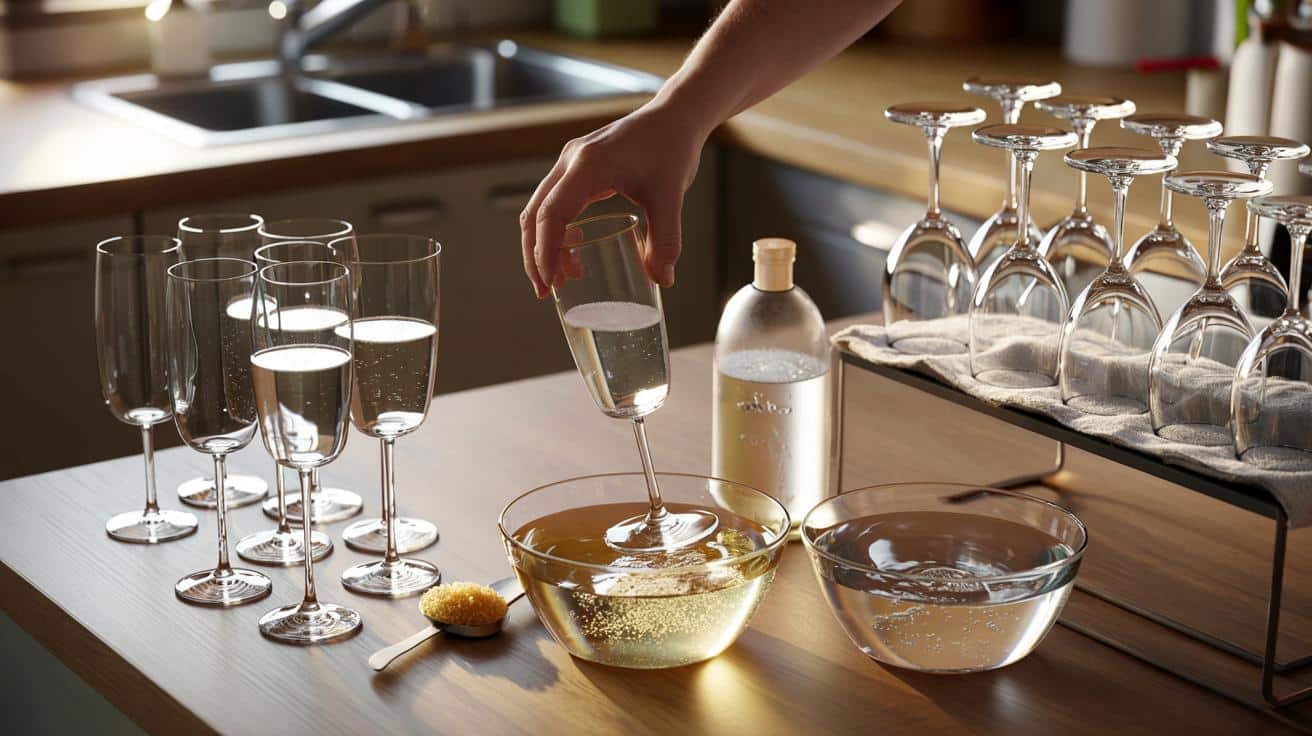
Here’s the move that turns “Bicchieri della festa opachi” into “wow”: a two-part finish. After washing, dunk each glass in a warm bath of 4 cups/1 liter water plus 1/4 cup/60 ml white vinegar (5%). Swirl for 10 to 20 seconds. Lift, shake once, then dip the rim into a second bowl of warm distilled water. Stand the glass upside down on a microfiber-lined rack. No towel yet. Distilled water dries without mineral spots, and the quick acid bath resets the surface. **The secret is a two-step rinse: acid, then distilled water.**
If your water is very hard, go slightly stronger on the acid dip (up to 1:6 vinegar-to-water) for troublemakers like flutes and coupes. Crystal prefers a shorter dip and cooler water, so keep it gentle and quick. Avoid scalding heat, which can lock spots in as they flash-dry. Let’s be honest: nobody does that every day. Use the full ritual for party glassware, and on weeknights, at least finish with a distilled-water dunk. It’s the last rinse that writes the story your eyes will read.
Caution lives here, kindly. Skip abrasive powders and salt scrubs that etch the surface. They don’t “restore,” they roughen. **Never scrub cloudy film with abrasive powders.** Choose a lint-free cloth for the final touch if you must polish, and make it a light kiss, not a workout.
“If your tap water is hard, the last rinse decides the shine.”
- For carafes and narrow flutes: add a spoon of uncooked rice to the vinegar bath, swirl, then rinse in distilled water.
- For lipstick ghosts: pre-wipe the rim with a drop of alcohol, then do the two-step rinse.
- Dishwasher users: turn on rinse aid and run a short extra rinse with softened water or a distilled-water pour-over at the end.
Keep the sparkle without babying your glassware
Think of brightness as a routine, not a rescue. Use the two-step for party cleanups, and keep a jug of distilled water under the sink for grab-and-go finishing. If a glass is already hazy, soak it for five minutes in a mild citric acid bath (1 teaspoon per cup of warm water), then do the two-step. Dry upside down on microfiber so air can pass under the rim. **If your tap water is hard, the last rinse decides the shine.** It’s not more work. It’s smarter work.
Dishwasher loyalists aren’t doomed. Space glasses so they don’t touch, choose a gentle cycle, and keep the rinse-aid reservoir filled. Use dishwasher salt if your machine takes it. For extra credit, crack the door open right after the cycle and quickly pour a cup of distilled water over the top rack, letting it cascade down as steam escapes. That tiny ritual keeps minerals from baking on while everything is still hot.
For long-term love, treat the surface like skin. Hot water, mild detergent, soft tools. Drying is a choreography: upside down first, then a short breath of air, then a soft-cloth pass if needed. Store stems upright with space between them so micro-scratches don’t form from nicks. If a glass looks permanently milky, you might be seeing etching rather than residue. Test by dipping half the bowl in vinegar; if only half clears, you’re dealing with deposits. If nothing changes, it’s etched, and the best move is prevention going forward.
Shine that starts conversations
People notice the way light lands on a table. A clear rim brightens a drink, and a bright drink changes the mood. The tiny habit of an acid dip and a distilled-water finish turns clean into crisp, and crisp into memorable. You can turn “good enough” into crisp sparkle in under two minutes per dozen glasses, which matters when friends are still humming from the playlist. Sometimes the smallest backstage tweak steals the show. And the show is the clink, the laugh, the glass that looks like a little bell of light.
| Point clé | Détail | Intérêt pour le lecteur |
|---|---|---|
| Acid quick dip | Warm water + white vinegar (1:16 to 1:6) for 10–20 seconds | Dissolves mineral film and detergent residue fast |
| Distilled-water finish | Second rinse in low-mineral water, then air-dry on microfiber | Prevents new spots, leaves a mirror-flat surface |
| Gentle handling | No abrasives, soft cloth, spaced storage, mild heat | Preserves clarity over time, avoids etching |
FAQ :
- What actually causes that milky haze on party glasses?Mostly mineral deposits from hard water binding with detergent residue as the glass dries. Add in lipstick wax, dried sugars, or micro-scratches from gritty sponges, and you get light scatter instead of a clean reflection.
- Can I fix cloudiness that looks permanent?Try the vinegar dip plus distilled-water finish. If the haze vanishes, it was residue. If nothing changes, it’s likely etching—microscopic pitting that cannot be reversed at home. Prevention is the real cure for etching.
- Is vinegar safe for crystal and decorated glass?Yes for a quick, cool dip, not a long soak. Keep it brief with crystal and decals. Rinse in distilled water, then air-dry. For heavy build-up, use a mild citric-acid bath instead of aggressive scrubbing.
- What’s the best dishwasher strategy for sparkle?Use rinse aid, avoid crowding, and choose a gentle cycle. Right after the cycle ends, open the door and pour a cup of distilled water over the top rack to chase off minerals as steam escapes. Let everything air out before putting away.
- Do I need special cloths to polish?Microfiber or a lint-free bar towel works. Polish lightly and only after the glass is nearly dry. Over-polishing grinds tiny particles into the surface, which looks duller over time.