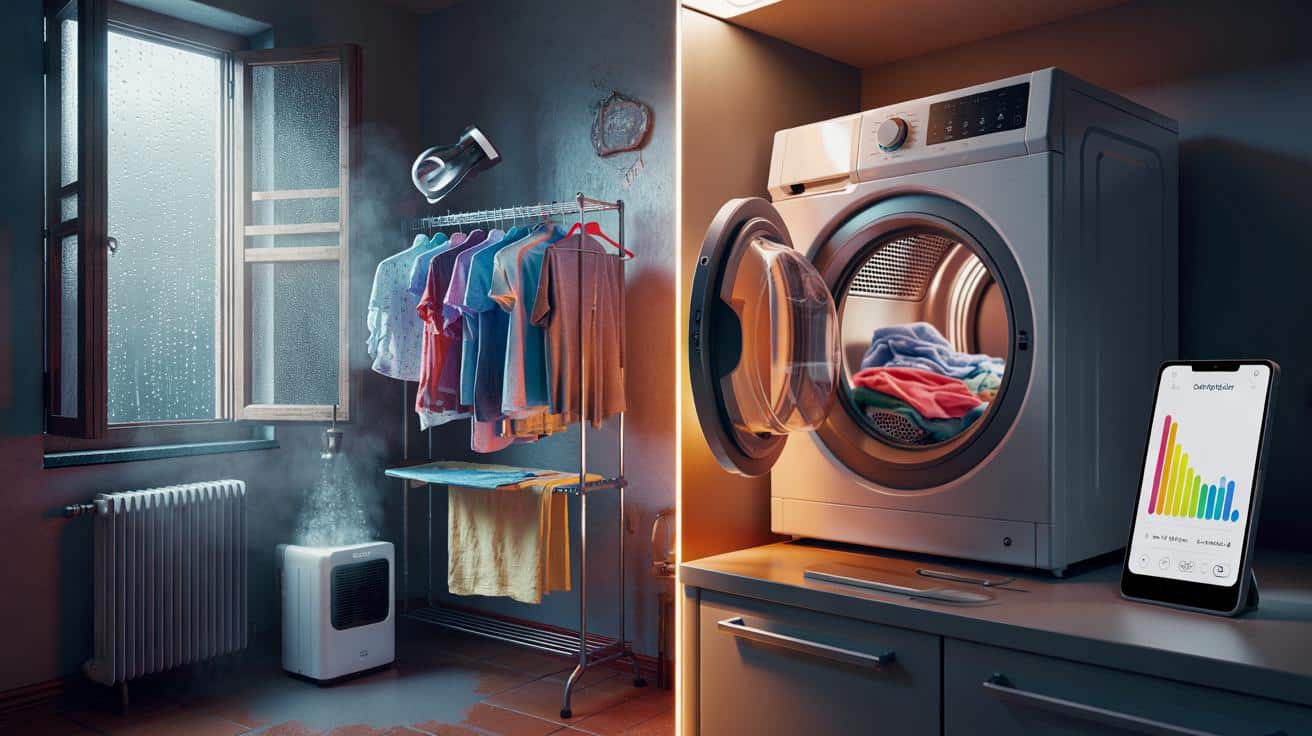
Are you? Between hidden heating losses, damp walls, and the surprising efficiency of modern heat‑pump dryers, the answer isn’t as obvious as it looks on a rainy Tuesday.
The radiator ticked as the glass fogged over. Socks swayed on a metal rack by the kitchen door, the air smelling faintly of detergent and steam. I nudged the window open to stop the mirror from weeping, and a finger of cold pushed across the room like a quiet admonishment.
My phone pinged with the energy app’s graph: a gentle hump in gas use as the room cooled and reheated. We’ve all had that moment where the bill arrives and we try to remember how many loads we did that week. The numbers tell a story.
The truth is hiding in the air.
Indoor rack vs tumble dryer: the real energy picture
Evaporating water isn’t free, even if it feels domestic and harmless. Every liter that leaves your clothes steals about 0.68 kWh of heat from your room as latent energy. **Indoor drying isn’t free: you’re paying in heat.**
Think of a typical 5 kg cotton load after a decent spin: roughly 2 liters of water still clinging to the fibers. That’s 1.36 kWh of heat sucked from the room as it dries. If your home is heated with gas at around €0.12 per kWh of heat, that single load quietly adds about €0.16 in extra heating. Use electric resistance heat and the penalty is bigger; use a heat pump to heat the room and it’s smaller.
Now zoom out. If you open a window to purge moisture, you also warm a lot of cold outdoor air. Winter example: run a bathroom fan or crack a window for two hours and you can lose another 1–2 kWh of heat, depending on climate and airflow. **A modern heat‑pump dryer often beats a leaky window.** With a good heat‑pump dryer using 1.0–1.8 kWh per cycle at €0.30/kWh, you’re near €0.30–€0.54. Old-school condenser at 3–4 kWh? That’s €0.90–€1.20. The rack wins on paper only if you don’t throw away heat to manage humidity.
Dry smarter at home: methods that actually move the needle
Start with a high spin. Push your washer to 1,200–1,400 rpm and you can cut a half‑liter or more before drying even begins. Then create airflow: a cheap desk fan aimed across the rack, clothes spaced with gaps, and a small dehumidifier set to 50–55% RH in a closed room. The dehumidifier turns vapor back into water and its electricity becomes gentle room heat, so in heating season the extra cost can be surprisingly low.
Avoid drying in the main living room unless you like cleaning windows and repainting corners. Don’t pile garments; single layers dry faster than doubles, every time. Let’s be honest: nobody actually does that every day. Clean lint filters on dryers, crack doors in tiny laundry closets, and don’t drape clothes directly on radiators, which can trap moisture against walls and drive condensation where you can’t see it.
“If you can smell ‘wet laundry’ in the hallway, your walls are absorbing the story too.” — a building physicist said that to me in a basement laundry in Parma, and the paint flakes nodded.
- Rule of thumb: 1 liter evaporated indoors = ~0.68 kWh of extra heat needed.
- Heat‑pump dryer: ~1.0–1.8 kWh per cycle; condenser/resistance: ~3–4 kWh.
- Rack + window purge in winter: often 1.5–3.0 kWh of total heat lost per load (evaporation + ventilation).
- Dehumidifier yield: ~1.5–2.5 liters removed per kWh; set target around 50–55% RH.
- Safe indoor range: 40–60% RH; below that feels dry, above that invites mold.
So, which one is cheaper for you?
There’s a clean way to decide at home, without a PhD. Count liters, price heat, then compare to your dryer. One liter costs ~0.68 kWh of heat. Two liters is ~1.36 kWh. Multiply by your real heating cost per delivered kWh, not the fuel sticker. Add any ventilation losses you create by opening windows to fight foggy glass. Compare that number to your dryer’s consumption on the energy label or smart plug. **Mold is far more expensive than one laundry cycle.**
The twist is seasonal psychology. In winter, a fan plus dehumidifier in a closed room can beat a window purge and sometimes rival a heat‑pump dryer on cost, while keeping RH stable. In mild spring weather with windows open anyway, the rack is nearly free. In a small flat with cold bridges and streaky paint, the dryer is the cheapest insurance you’ll ever buy. Your home answers the question if you give it five quiet minutes and a hygrometer.
| Point clé | Détail | Intérêt pour le lecteur |
|---|---|---|
| Energy per liter | ~0.68 kWh of heat per liter evaporated | Quick mental math for any load |
| Heat‑pump dryer baseline | ~1.0–1.8 kWh per cycle | Clear cost target to beat |
| Rack + window penalty | Often +1.5–3.0 kWh heat loss per load | Explains why “free” drying isn’t free |
FAQ :
- How do I estimate the liters in my load?Weigh the laundry dry, then weigh it right after the spin. The difference in kilograms is liters of water. No scale? A 5 kg cotton load after a strong spin often holds about 1.5–2.5 liters.
- Does a dehumidifier really help in winter?Yes. It converts vapor to liquid and its electricity becomes room heat. You pay the kWh to run it, but you also get that heat back, which can offset part of your space heating.
- What about summer with air‑conditioning?Moist air makes AC work harder. Drying on a rack indoors adds latent load. Your AC will remove it, which costs energy. In hot, humid spells, a heat‑pump dryer or outdoor drying wins.
- Is a condenser dryer always a bad deal?Not always. If your electricity is cheap and you need speed or can’t ventilate, it’s simple and predictable. Heat‑pump models still tend to cost half or less per cycle over a year.
- What humidity target should I aim for?Keep indoor RH around 40–60%. If a drying session pushes you past 60% for more than a couple of hours, switch to a dehumidifier or the dryer, or isolate the drying room.